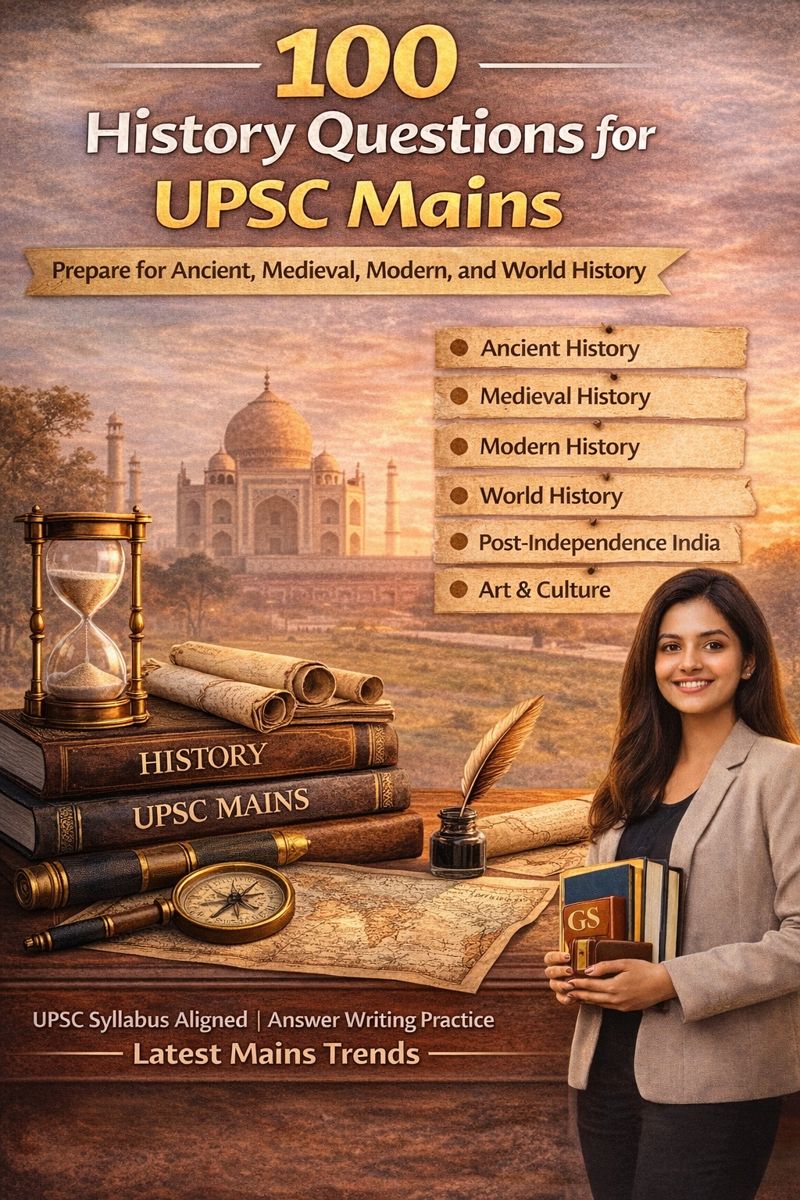
History is a core component of UPSC Mains GS Paper I and an important area for aspirants preparing History Optional. Questions in UPSC Mains require conceptual clarity, analytical depth, and the ability to link historical developments with broader socio-political processes.
To support focused preparation, here is a carefully curated list of 100 History Questions for UPSC Mains. These questions are aligned with the latest UPSC syllabus and answer-writing trends and encourage multidimensional thinking.
Coverage of the 100 History Questions
Ancient Indian History
- Discuss the significance of the Harappan civilization in the context of urban planning.
- Examine the socio-economic life of the Rig Vedic period.
- Analyze the transition from Rig Vedic to Later Vedic society.
- Discuss the religious and philosophical ideas of Buddhism.
- Examine the causes for the rise of Jainism in ancient India.
- Discuss Mauryan administration with special reference to Ashoka.
- Analyze the economic life during the Mauryan period.
- Discuss the cultural achievements of the Gupta period.
- Examine the role of Sangam literature in understanding South Indian history.
- Analyze the decline of ancient Indian urban centers.
Medieval Indian History
- Discuss the nature of the Delhi Sultanate administration.
- Examine the role of Iqta system in medieval India.
- Analyze the causes of the rise of Bhakti movement.
- Discuss Sufism and its impact on Indian society.
- Examine Mughal administrative reforms under Akbar.
- Analyze the Mansabdari system and its significance.
- Discuss agrarian relations during the Mughal period.
- Examine the cultural synthesis during medieval India.
- Discuss the decline of the Mughal Empire.
- Analyze the role of regional kingdoms in medieval India.
Modern Indian History (1757–1947)
- Discuss the causes and consequences of the Battle of Plassey.
- Analyze the economic impact of British colonialism on India.
- Discuss the Permanent Settlement and its effects.
- Examine the Revolt of 1857 as the first war of independence.
- Analyze the role of tribal movements in colonial India.
- Discuss the growth of Indian nationalism in the late 19th century.
- Examine the role of press and literature in freedom struggle.
- Analyze the significance of the Non-Cooperation Movement.
- Discuss the Civil Disobedience Movement and its outcomes.
- Examine the Quit India Movement of 1942.
Indian National Movement
- Discuss the role of Mahatma Gandhi in India’s freedom struggle.
- Analyze the contribution of Subhas Chandra Bose.
- Examine the significance of the Home Rule Movement.
- Discuss the role of women in the Indian national movement.
- Analyze revolutionary movements in India.
- Discuss peasant movements during the freedom struggle.
- Examine the role of Constituent Assembly in nation building.
- Analyze the Cabinet Mission Plan.
- Discuss the causes of Partition of India.
- Examine the integration of princely states.
World History
- Discuss the causes of the French Revolution.
- Analyze the impact of the Industrial Revolution on society.
- Examine the unification of Germany.
- Discuss the unification of Italy.
- Analyze the causes of the American War of Independence.
- Discuss the Russian Revolution of 1917.
- Examine the causes and consequences of World War I.
- Analyze the Treaty of Versailles.
- Discuss the causes of World War II.
- Examine the Cold War and its global impact.
Post-Independence India
- Discuss the challenges faced by India after independence.
- Analyze the process of linguistic reorganization of states.
- Examine India’s foreign policy during the Nehru era.
- Discuss land reforms in post-independence India.
- Analyze the Green Revolution and its impact.
- Discuss the Emergency of 1975.
- Examine India’s economic reforms of 1991.
- Discuss the evolution of Panchayati Raj institutions.
- Analyze India’s nuclear policy.
- Examine social change in post-independence India.
Art and Culture
- Discuss the evolution of Indian temple architecture.
- Examine the features of Indo-Islamic architecture.
- Discuss the development of classical dances in India.
- Analyze the significance of Buddhist art and architecture.
- Discuss the role of literature in Indian cultural history.
- Examine folk traditions and their historical relevance.
- Discuss the contribution of Bhakti saints to Indian culture.
- Analyze Mughal painting tradition.
- Discuss the evolution of Indian music.
- Examine cultural developments during the Gupta period.
Social and Economic History
- Discuss the caste system in ancient India.
- Analyze agrarian relations in medieval India.
- Examine the impact of colonial education policy.
- Discuss the drain of wealth theory.
- Analyze industrial development during British rule.
- Discuss labor movements in colonial India.
- Examine tribal resistance movements.
- Analyze the impact of colonialism on Indian society.
- Discuss urbanization in colonial India.
- Examine social reform movements in 19th century India.
Historiography and Applied History
- Discuss different schools of Indian historiography.
- Analyze the contribution of colonial historians.
- Examine nationalist interpretation of Indian history.
- Discuss Marxist historiography in India.
- Analyze subaltern studies approach.
- Discuss the use of archaeology in reconstructing history.
- Examine the importance of inscriptions and numismatics.
- Discuss historical geography of India.
- Analyze oral traditions as historical sources.
- Examine the relevance of history in policy making.
Current-Oriented History Questions
- Discuss the relevance of freedom struggle values today.
- Analyze the importance of heritage conservation in India.
- Examine debates around rewriting history.
- Discuss history’s role in nation building.
- Analyze the significance of Azadi Ka Amrit Mahotsav.
- Discuss colonial legacies in modern India.
- Examine global memory politics and history.
- Analyze the role of museums in preserving history.
- Discuss historical roots of regional identities.
- Examine how history helps in understanding contemporary conflicts.
How to Use These Questions
Aspirants should write answers in 150 or 250 words, include timelines, maps, and examples, and practice regular evaluation. Consistent answer writing using these questions will improve structure, depth, and confidence for UPSC Mains.
